
LEVELS EXPLAINED
From your first “Hola” to confident conversations.
Our levels are designed to guide you through a clear progression of Spanish communication skills. Explore the path below to see what you’ll be able to understand, say, and accomplish at each stage of your learning journey.
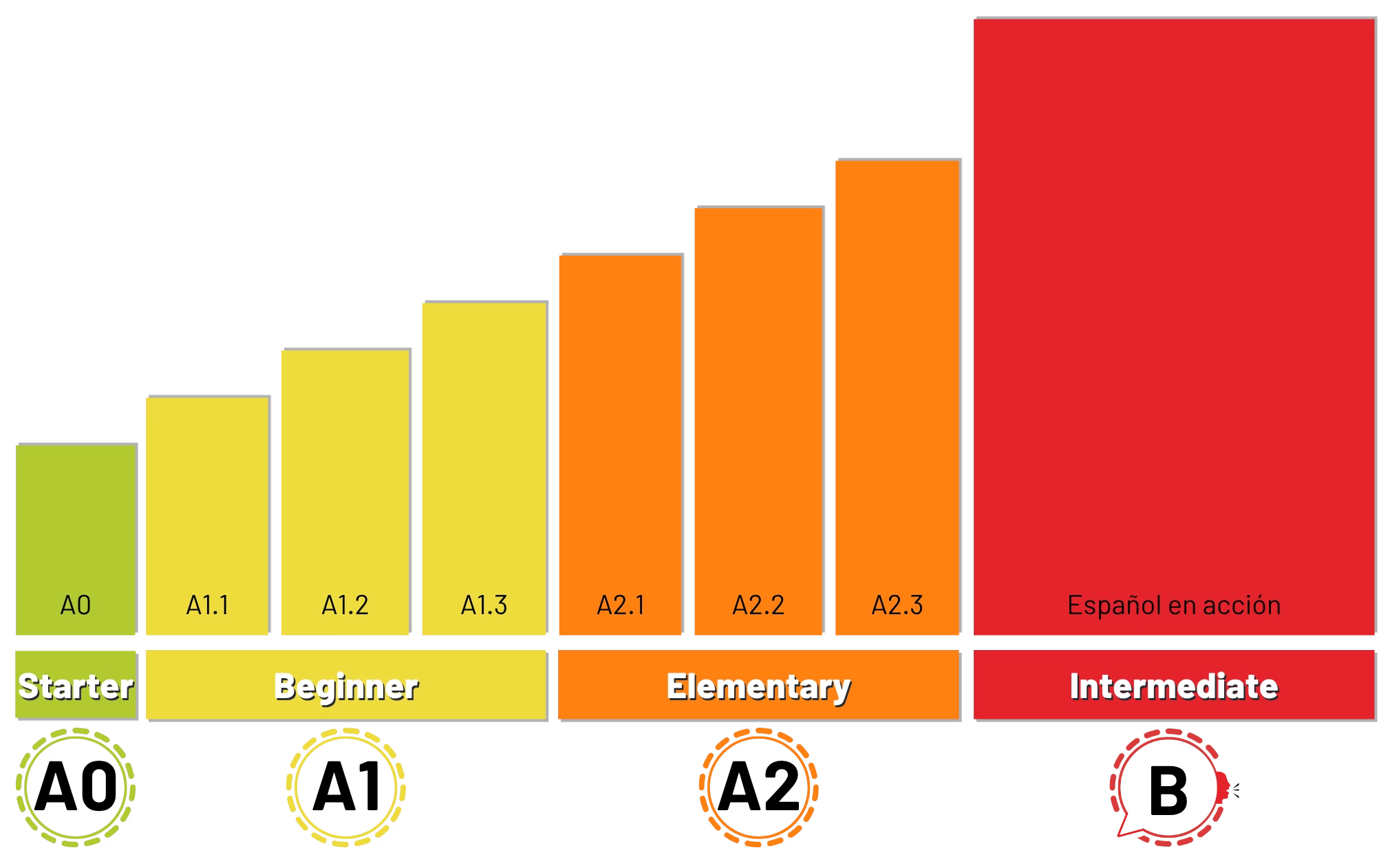
Not sure about your level? Take our assessments and find out.
Understanding Our Levels
Our Spanish program is based on the Common European Framework of Reference for Languages (CEFR), an international standard used to describe language proficiency.
We currently offer courses from A0 (Absolute Beginner) through B1 (Intermediate).
How the levels work
Each CEFR level is divided into several courses. For example, the A1 level consists of three courses: A1.1, A1.2, and A1.3.
These courses are designed to build on one another, with each course introducing new vocabulary, grammar, and communication skills. As a result, later courses within the same level may feel more challenging than earlier ones.
Do I have to take them in order?
The recommended path is to complete the courses in sequence. However, students may enroll in a different course within their assigned CEFR level when scheduling or course availability makes this necessary.
For example, a student placed at the A1 level may take any available A1 course, but should not enroll directly in an A2 course.
What can I do at each level?
The descriptions below summarize what students can typically do by the end of each level.

Who is this level for?
Students with no prior knowledge of Spanish or those who would like to review the fundamentals before starting A1. This is the only level that does not require a placement test.
By the end of this level, I can:
- Introduce myself and greet others.
- Use the Spanish alphabet and numbers 1–20.
- Ask and answer simple personal questions.
- Give basic information about myself.
- Ask for help when I don’t understand.
- Describe people, objects, and hobbies using simple Spanish.

Who is this level for?
Students who can already use basic Spanish expressions and communicate in very simple situations, but who need to expand their vocabulary and gain confidence discussing everyday topics.
By the end of this level, I can:
- Introduce myself and others, and exchange basic personal information.
- Talk about my family, daily routine, hobbies, and interests.
- Describe people, places, and my home using simple language.
- Express likes, dislikes, preferences, and needs.
- Ask for and give directions in familiar places.
- Talk about food, shopping, travel, and other everyday situations.
- Describe past experiences in a simple way.
- Understand and participate in short conversations on familiar topics.

Who is this level for?
Students who can communicate confidently in the present tense and are ready to expand their ability to talk about past experiences, future plans, opinions, and a wider range of everyday situations.
By the end of this level, I can:
- Describe my experiences, personal history, and important life events.
- Talk about past, present, and future activities using connected sentences.
- Express opinions, preferences, and recommendations, and explain my reasons.
- Handle common situations related to travel, shopping, dining, and health.
- Ask for and give directions, instructions, and practical information.
- Participate in longer conversations about familiar topics with greater confidence.
- Understand the main ideas of clear spoken and written Spanish on everyday subjects.
- Describe plans, goals, and expectations for the future.

Español en Acción: A conversation-based fluency program for intermediate learners
Who is this level for?
Students who can already communicate about everyday topics in Spanish and are ready to move beyond structured language practice toward greater fluency, confidence, and spontaneity in conversation.
Throughout this level, I can:
- Tell stories and describe experiences in greater detail.
- Express opinions, agree and disagree, and support my ideas with reasons and examples.
- Give advice, make recommendations, and influence decisions.
- Discuss possibilities, hypothetical situations, and future outcomes.
- Compare alternatives, evaluate options, and solve problems collaboratively.
- React naturally to information, express emotions, and respond to different viewpoints.
- Reformulate information and explain ideas in different ways.
- Communicate with increasing fluency, flexibility, and confidence in real-world situations.
How is the intermediate level different?
Español en Acción develops fluency through structured communicative tasks rather than a traditional grammar sequence. Each 10-week block explores different themes and communication challenges while continuously revisiting and expanding key B-level grammar, vocabulary, and communication skills. Students may join any block and continue building their Spanish over time.